Intracorneal Ring Segments (ICRS): Flattening the Cone & Correcting Astigmatism
When spectacles or soft contact lenses no longer correct the vision distortion caused by keratoconus, Intracorneal Ring Segments (ICRS) offer a tissue-preserving surgical solution to reshape the cornea and stabilize visual acuity.

Key Takeaways for Patients
- Mechanical Flattening: ICRS arcs are placed into the corneal stroma to pull back the central cone and smooth out irregular astigmatism.
- Femtosecond Laser Precision: Micro-channels are created in seconds using high-precision laser energy without manual blades.
- Tissue Preserving & Reversible: No corneal tissue is removed during implantation, and ring segments can be exchanged or removed if necessary.
- Combination Therapy: Frequently performed in conjunction with Corneal Cross-Linking (CXL) to stabilize the cornea while improving optical clarity.
What Are Intracorneal Ring Segments (ICRS)?
Intracorneal Ring Segments (ICRS)—commonly known by brand names such as Keraring, Ferrara Rings, or Intacs—are arc-shaped, biocompatible micro-implants made of PMMA (Polymethyl Methacrylate). They are inserted deep within the peripheral corneal stroma (at roughly 75% to 80% depth) outside the central visual zone.
By acting as internal structural supports, these arc segments shorten and flatten the central steep area of the cone. This converts an asymmetrical, cone-shaped cornea back into a more symmetrical optical dome, significantly decreasing high-order aberrations and irregular astigmatism.
The Femtosecond Laser Advantage in ICRS Implantation
Historically, ring channels were created manually using mechanical dissectors. Modern corneal surgery utilizes ultra-fast Femtosecond lasers to create intrastromal channels with sub-micron accuracy in under 10 seconds.
Surgical Steps During Femto-ICRS
- 3D Topography Mapping: Pre-operative Pentacam or OCT scans dictate the exact thickness, arc length, and position of the ring required for your specific cone orientation.
- Laser Channel Creation: The Femtosecond laser creates a precise circular tunnel at an exact stromal depth without incising central tissue.
- Segment Placement: Dr. El-Naggar glides the customized ring segment into the laser channel under surgical magnification.
- Rapid Recovery: The microscopic entry incision seals naturally without stitches, allowing visual stabilization within days.
Who Is an Ideal Candidate for ICRS Surgery?
ICRS implantation is specifically indicated for patients who meet the following clinical criteria:
- A clear central cornea free of deep, central scarring.
- Intolerance to rigid gas-permeable (RGP) or scleral contact lenses.
- Mild-to-moderate keratoconus with sufficient peripheral corneal thickness (>400 microns at the insertion zone).
- Uncorrected visual acuity that cannot be adequately restored with glasses.
Comparing Common ICRS Technologies
| Ring Profile / Type | Cross-Section Shape | Primary Clinical Application |
|---|---|---|
| Keraring / Ferrara Rings | Prismatic / Triangular | Maximal flattening effect for asymmetrical central and eccentric cones. |
| Intacs / Intacs SK | Hexagonal / Oval | Mild central ectasia and post-LASIK ectasia regularization. |
| Asymmetric Ring Segments | Variable Thickness Arc | Targeted flattening for highly uneven, irregular astigmatism profiles. |
Struggling with Contact Lens Intolerance or Irregular Astigmatism?
Schedule a specialized Femto-ICRS evaluation with Dr. Mohamed El-Naggar to determine if ring implantation can restore your optical clarity.
Book Your Diagnostic ConsultationCombining ICRS with Corneal Cross-Linking (CXL)
While ring segments successfully reshape the cornea to improve visual acuity, they do not arrest the underlying biomechanical weakening caused by progressive keratoconus. To ensure long-term stability, Dr. El-Naggar often combines Femto-ICRS with Corneal Cross-Linking (CXL).
In this combined approach, the ring segment first regularizes corneal curvature, and CXL is then applied to lock the flattened structure permanently into place.
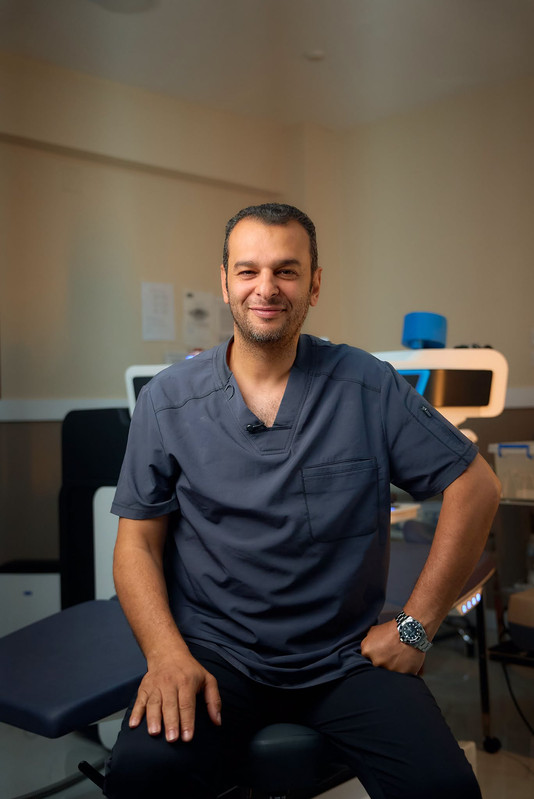
Dr. Mohamed El-Naggar
Dr. Mohamed El-Naggar is a Fellow of the Royal College of Surgeons of Edinburgh (FRCS) and the International Council of Ophthalmology (ICO Zurich). Founder of the Arabian Peninsula Eye & Femto-LASIK Center, he specializes in complex corneal ectasia management, partial-thickness corneal transplants (DALK/DMEK), and advanced laser vision correction across Egypt.
Frequently Asked Questions
Are intracorneal ring segments removable?
Yes. Unlike laser tissue ablation or corneal grafting, ICRS implantation is fully reversible and additive. If necessary, segments can be safely adjusted, exchanged, or removed without permanent damage to the corneal architecture.
Does ICRS surgery replace Corneal Cross-Linking (CXL)?
No. ICRS is designed to flatten the cone and improve visual acuity, whereas Cross-Linking halts structural disease progression. In progressive cases, ICRS and CXL are frequently combined in a unified treatment protocol.
Related Corneal Health Articles


