Restoring Clarity: PTK Laser Surgery for Corneal Scars
Phototherapeutic Keratectomy (PTK) uses advanced excimer laser technology to vaporize thin layers of scarred or opaque corneal tissue. Discover how PTK restores optical transparency and smooths irregular surfaces, avoiding the need for invasive corneal transplants.

Key Takeaways
- Precision Scar Removal: PTK uses a 193nm excimer laser to ablate opacities microscopic layer by layer.
- Preserves Natural Tissue: Eliminates superficial scars without the need for donor tissue or graft rejection risks.
- Treats Dystrophies & Erosions: Highly effective for Epithelial Basement Membrane Dystrophy (EBMD) and Recurrent Corneal Erosion (RCE).
- Rapid Recovery: Re-epithelialization typically completes within 3 to 5 days under a protective bandage contact lens.
What is Phototherapeutic Keratectomy (PTK)?
Phototherapeutic Keratectomy (PTK) is an excimer laser procedure designed to treat superficial corneal surface disease and opacities. Unlike Photorefractive Keratectomy (PRK), which focuses on reshaping the healthy cornea to correct refractive errors, PTK is a therapeutic treatment aimed at removing pathological tissue from the anterior layers of the cornea.
By using sub-micron ultraviolet laser pulses, PTK precisely removes altered tissue while leaving underlying clear stroma intact, creating a smooth optical surface.
Primary Clinical Indications
Conditions Treated by PTK
| Clinical Condition | Pathology & Symptoms | PTK Therapeutic Goal |
|---|---|---|
| Superficial Corneal Scars | Opacities resulting from healed infections, mild trauma, or pterygium excision | Ablates scar tissue to clear the visual axis and restore optical transparency |
| Anterior Corneal Dystrophies | Reis-Bücklers, Thiel-Behnke, Granular, or Lattice dystrophies affecting anterior stroma | Removes proteinaceous deposits without deep surgical incisions |
| Recurrent Corneal Erosion (RCE) | Weak hemidesmosomal attachment causing painful epithelial breakdowns upon waking | Creates a smooth basement membrane floor to foster strong epithelial re-adhesion |
| Salzmann Nodular Degeneration | Elevated bluish-white stromal nodules causing irregular astigmatism | Smooths the elevated surface to restore a stable tear film and clear vision |
Surgical Procedure & Smoothing Fluids
During the procedure, topically anesthetized corneal epithelium is gently removed. The surgeon applies a masking fluid with a refraction index matching healthy stromal tissue over the cornea. As the excimer laser scans across, the fluid shields deeper valleys while allowing elevated scar peaks to be selectively ablated, producing an exceptionally smooth surface.
At the conclusion of PTK, a protective bandage contact lens is placed on the eye to promote comfortable epithelial healing over the subsequent 3 to 5 days.
Suffer from Recurrent Corneal Erosions or Scars?
Consult with Dr. Mohamed El-Naggar to determine if PTK laser surgery can restore clear, pain-free vision.
Schedule a PTK Consultation
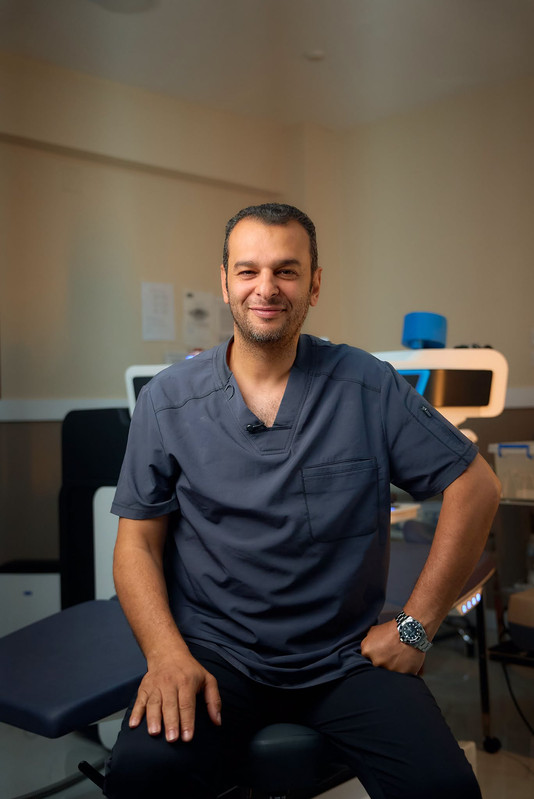
Dr. Mohamed El-Naggar
Dr. Mohamed El-Naggar is a Fellow of the Royal College of Surgeons of Edinburgh (FRCS) and the International Council of Ophthalmology (ICO Zurich). Founder of the Arabian Peninsula Eye & Femto-LASIK Center, he specializes in excimer laser surface treatments, corneal dystrophy management, and anterior segment reconstruction across Egypt.
Frequently Asked Questions
What is the difference between PRK and PTK?
PRK (Photorefractive Keratectomy) is performed to correct refractive errors such as myopia or astigmatism, whereas PTK (Phototherapeutic Keratectomy) removes diseased or scarred anterior corneal tissue to restore optical clarity.
Can PTK treat deep corneal scars?
PTK is most effective for superficial corneal opacities located in the anterior third of the stroma. Deep scars extending toward the endothelium usually require partial or full-thickness corneal transplantation.
Related Corneal & Refractive Articles


